
and Injection Methods for Composite Materials
A manufacturing process in which the fabric fibers are placed in a mold and the resin is injected in a controlled manner after the mold is closed. The method makes it possible to produce parts with complex geometries while maintaining product uniformity and a quality surface finish on both sides of the product. The RTM process also allows inserts, bushings, electronic systems and additional components to be embedded in the product during manufacturing, thereby reducing assembly and processing operations at later stages.
A closed-mold manufacturing process in which the fabric fibers are placed between a rigid female mold and a light, flexible male mold. The resin is injected at low pressure, using vacuum to close the mold and impregnate the fabric. The method is suitable for serial production of large and complex parts and allows good control over impregnation and resin distribution, efficiency, consistent weight and controlled wall thickness.
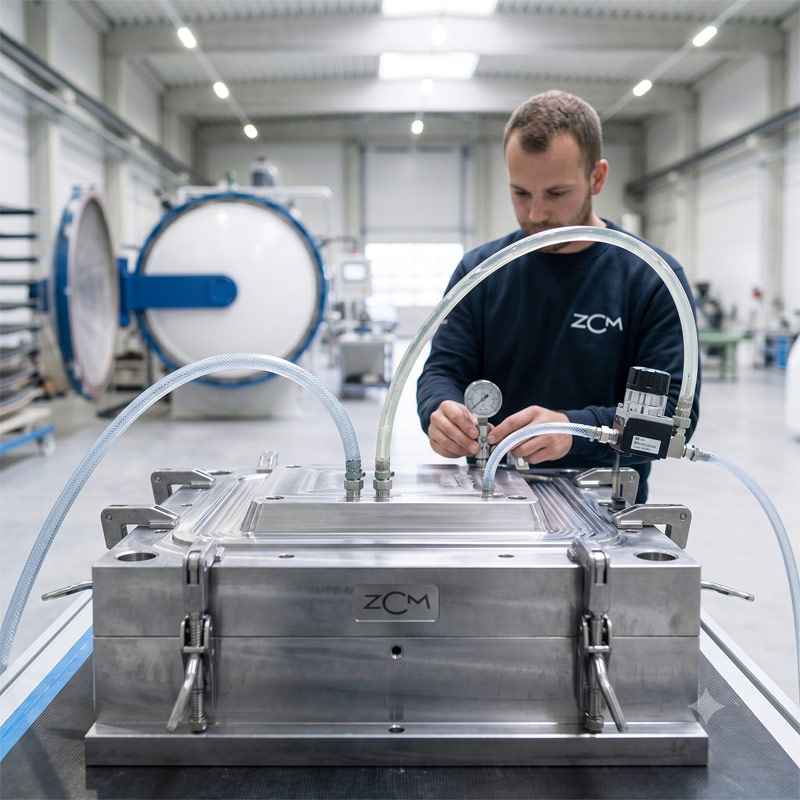
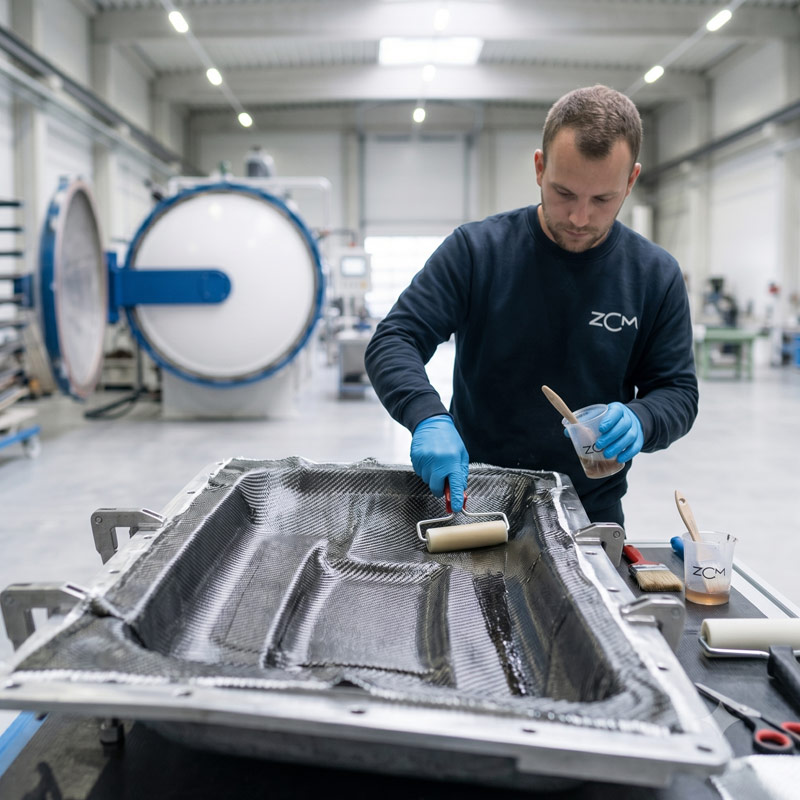
A process in which layers of reinforcement material are placed in a mold and impregnated with resin manually and in a controlled manner. The method offers high flexibility in manufacturing parts of various geometries and dimensions, and is especially suited to prototypes, small series and large parts.
A process in which, after the fabric layers are laid and impregnated with resin, the part is sealed with a vacuum bag. The vacuum applies uniform pressure on the layers and helps consolidate them, remove air and excess resin, and improve the uniformity of the structure and the mechanical properties of the part.
A process in which dry layers of reinforcement material are placed in a mold and sealed with a vacuum bag. Once the vacuum is created, resin is drawn from an external container and flows through the reinforcement layers until they are impregnated in a controlled manner.The method allows good control over the amount and distribution of resin, reduces internal voids and produces parts with a consistent fiber-to-resin ratio. The process is especially suited to manufacturing large parts that require low weight, structural strength and high quality.
A closed-mold manufacturing process in which the material is formed under pressure and, where required, at a controlled temperature. The method allows good control over product geometry and wall thickness, while producing parts with high uniformity and efficiency.
of Our Manufacturing Methods
♦ Full design and geometric freedom for complex and aerodynamic surfaces.
♦ Weight and strength optimization through variable wall-thickness design according to stress zones.
♦ High engineering precision that eases integration and the transition to continuous production lines.
♦ Extreme environmental resistance and products with a premium finish.